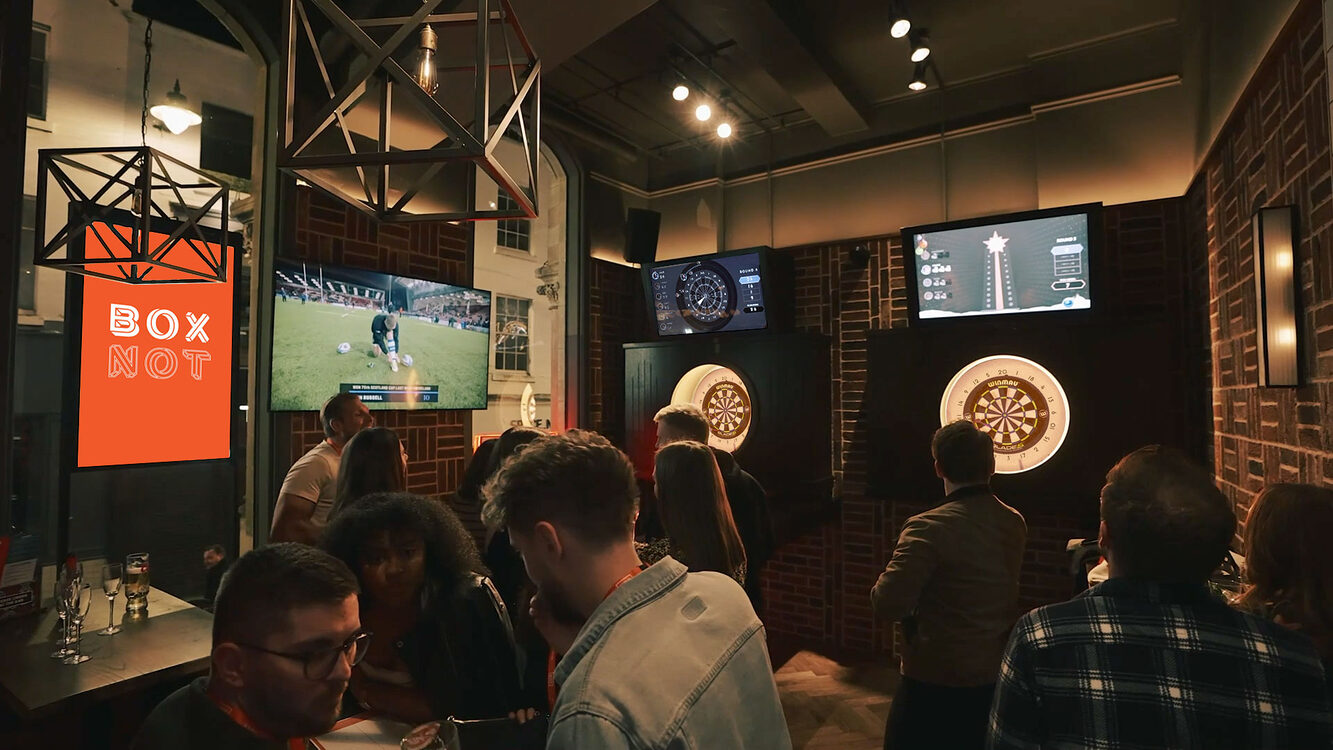
Why existing hospitality concepts don’t need a complete redesign to benefit from interactive experiences
Not every successful social gaming concept starts with a blank sheet of paper.
Much of the conversation around competitive socialising focuses on destination venues built entirely around the activity, and for good reason. Some of the sector’s strongest performers have built their entire proposition around immersive, experience-led gaming.
But that isn’t the only route to commercial success. For many operators, the bigger opportunity lies in integration rather than reinvention. Take BOX Nottingham.
Its proposition is clearly built around live sport. With dozens of screens, major sporting fixtures, food, drinks, and a strong event atmosphere, the venue is designed first and foremost as a sports-led hospitality experience.
Gaming is part of the offer, but it isn’t the main event.
And that’s exactly what makes it such a useful example. Because not every operator has the appetite, or the physical footprint, to commit to large-format competitive socialising concepts. Activities such as axe throwing, immersive golf, or full simulator experiences demand dedicated space, specialist infrastructure, and often a fundamental rethink of the operating model. That works brilliantly in the right environment. But for existing venues with a strong core proposition, it can be commercially unrealistic.
Compact social games are different.
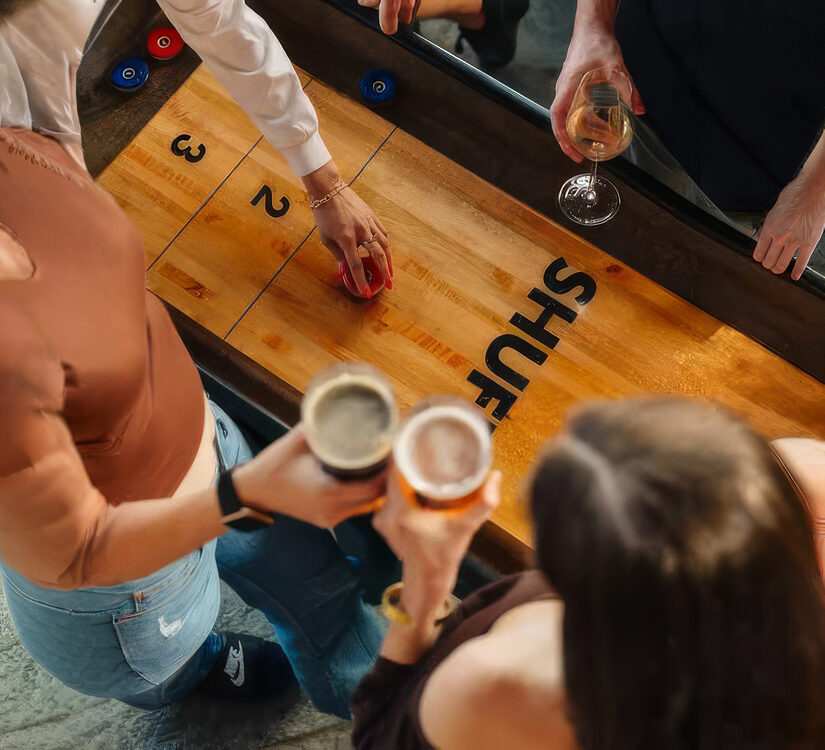
Experiences such as shuffleboard, interactive darts, and other shared competitive formats can be introduced into broader hospitality environments without displacing the venue’s primary purpose. They add an engaging social layer without requiring the business to become something entirely different – That flexibility matters.
For a sports-led venue, social gaming can extend dwell time before or after live fixtures. For group bookings, it creates another reason to choose one venue over another. For quieter trading periods, it introduces structured activity that drives engagement without relying solely on food and drink demand.
Most importantly, it allows operators to evolve without losing what already works. This is where the competitive socialising conversation can become unnecessarily binary. The choice isn’t always between building a full destination concept or doing nothing.
There’s a commercially viable middle ground.
For operators with established brands, loyal customer bases, and proven hospitality models, the right social gaming format can strengthen the existing proposition rather than replace it. The more useful question becomes:
Not “Should we reinvent our venue?”
But “What could we add that creates more reasons to visit?”
Increasingly, the answer may not be a wholesale transformation, but a smarter use of the space already available.
👉 Have a look at Social Games that can fit into your concept →
Franchise
B2B
You need to load content from reCAPTCHA to submit the form. Please note that doing so will share data with third-party providers.
More InformationYou are currently viewing a placeholder content from Turnstile. To access the actual content, click the button below. Please note that doing so will share data with third-party providers.
More Information