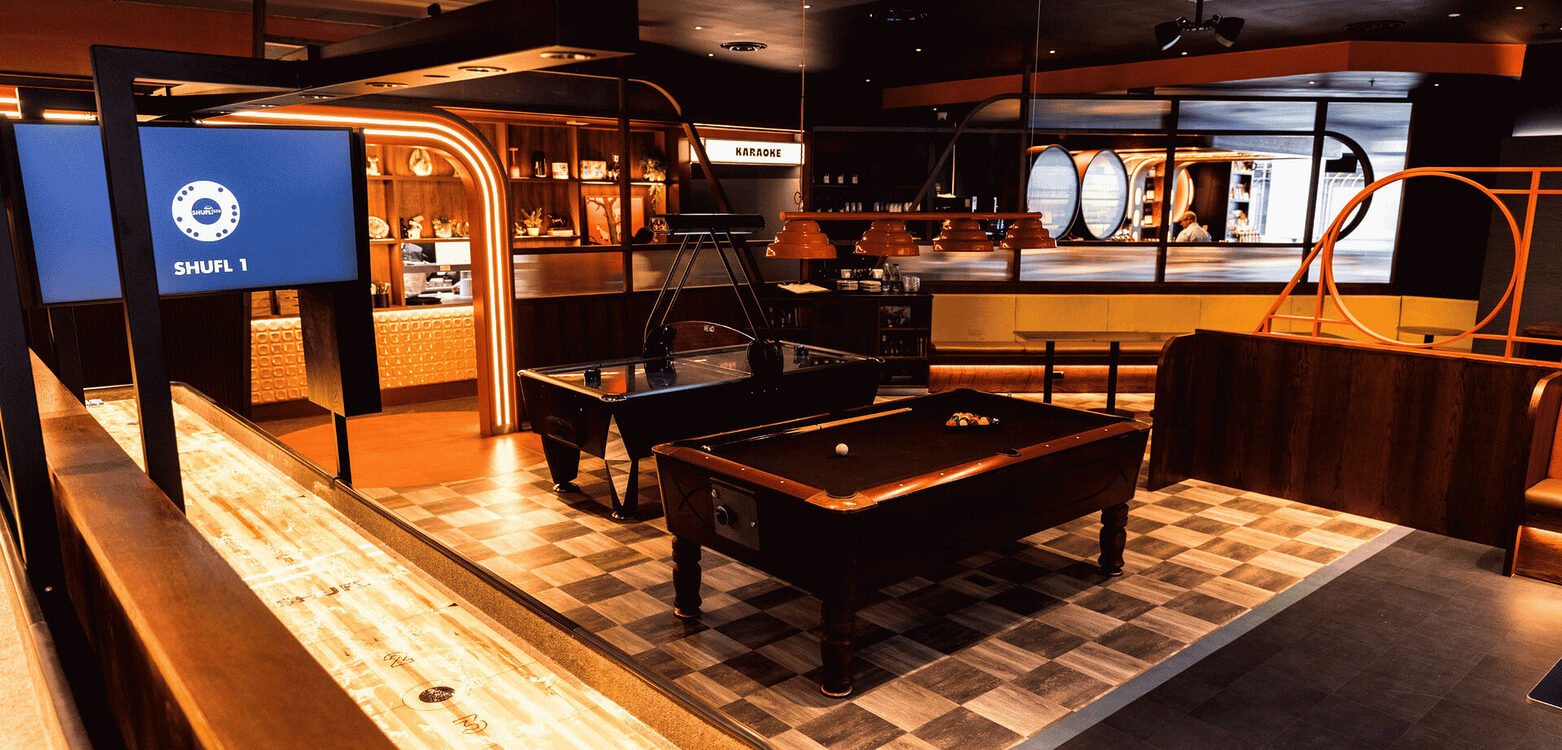
Why the most successful competitive socialising operators build around the experience, not on top of it.
Competitive socialising has moved well beyond trend status. What began as an emerging category has become one of hospitality’s most commercially compelling growth areas, with operators across the UK continuing to invest in experience-led formats that drive group bookings, longer dwell times, and stronger repeat visitation.
According to Savills’ latest market tracking, the UK competitive socialising sector now includes more than 800 active venues, up 58% since 2018. But growth figures only tell part of the story.
The more interesting divide is emerging between operators who are building sustainable, repeatable concepts – and those treating social gaming as an enhancement to an otherwise traditional hospitality offer. The difference often comes down to one question:
Is the game part of the experience, or is it the reason the experience exists?
It may sound like a subtle distinction. Commercially, it isn’t.
A market built on intent
Consumer behaviour is shifting in ways that strongly favour experience-led concepts. KAM’s 2025 consumer research found that 41% of competitive socialising visitors now return monthly, up from 35% the year before. More than a third of respondents also reported going out more frequently than they had 12 months earlier.
That isn’t casual engagement. It’s repeat behaviour driven by intention.
At the same time, CGA by NIQ data suggests high-tempo consumers are spending an estimated £38 more per month on-premise than the British average, a clear signal that socially driven experience-led audiences continue to outperform broader hospitality benchmarks. That premium rarely comes from incremental entertainment. It comes from guests arriving with a clear purpose.
When consumers book a social gaming venue, they’re not simply choosing somewhere to have a drink. They’re committing to an experience. That changes spending behaviour, group dynamics, and dwell time from the outset. KAM’s research also places average dwell time in competitive socialising venues at 86 minutes, already ahead of hospitality averages. For operators, that matters, because dwell time is far more commercially valuable when it’s driven by genuine engagement rather than passive lingering.
What successful operators are doing differently
Concepts like Fabrikken in Oslo and The Lucky Goat in London illustrate this shift particularly well. Neither feels like a conventional bar that happens to offer gaming. The activity is central to the proposition. Drinks, service, design, and atmosphere are all built to support the experience rather than lead it. The Lucky Goat describe their own venue by St Paul’s as a “games-led bar” – one built for nights out “that start after work and quickly turn into the whole evening.” The food and cocktails are genuinely strong, but they exist in service of the social experience, not as the draw in themselves. That positioning changes guest behaviour immediately. The booking conversation shifts from:
“Shall we go for drinks?” to “Let’s go and play.”
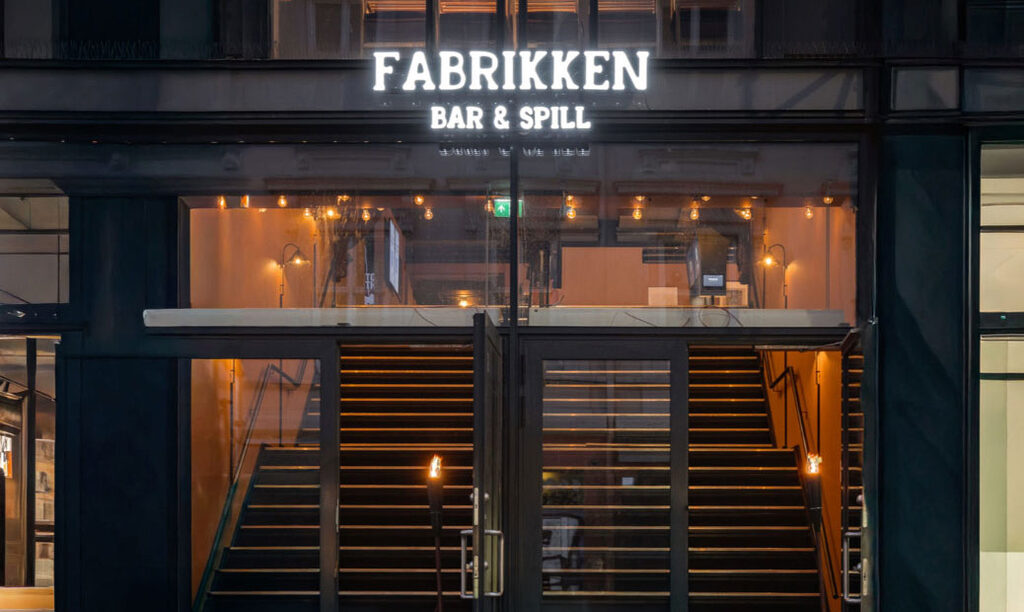
Fabrikken, Oslo.
That may seem like a small language shift, but commercially it’s significant. Experience-led bookings typically drive stronger group participation, better pre-booking behaviour, and more predictable revenue opportunities than passive walk-in trade. The strongest concepts create intentional demand, and intentional demand is easier to monetise.
It also drives something that remains one of hospitality’s most valuable commercial metrics: repeat visitation. Guests may remember a good cocktail bar, but they actively return to a compelling social gaming experience. More importantly, they bring others with them. That word-of-mouth loop is difficult to manufacture artificially, and incredibly valuable when it happens organically.
Hospitality still matters, but it serves a different purpose
None of this suggests hospitality becomes less important, quite the opposite. Food, drinks, service, and atmosphere remain essential–but in the strongest competitive socialising concepts, they support the main event rather than acting as the primary attraction. That shift changes how operators think about almost everything.
Space planning becomes experience-first. Booking systems become central to revenue strategy. Staff become part hosts, part facilitators. Marketing becomes less about venue credentials and more about experience design. Savills’ market commentary increasingly points to quality of experience as a defining differentiator as the sector matures. That makes strategic clarity even more important, because simply adding an activity is no longer enough.
What this means for operators
This doesn’t mean every venue needs to reinvent itself as a destination social gaming concept, but it does require honesty. If social gaming is part of the offer, operators need to ask whether it’s functioning as a genuine reason to visit–or simply as a feature layered onto an existing proposition – consumers notice the difference.
And in a more competitive market, concepts that feel secondary struggle to create lasting differentiation. The operators pulling ahead aren’t always the biggest, they’re the ones with the clearest proposition. Because the future of competitive socialising isn’t about adding games to hospitality, it’s about building hospitality around experiences people actively choose. And increasingly, the commercial winners understand one simple truth:
The game isn’t part of the product. The game is the product.
👉 Want to know how to create more reasons to visit your venue? Get in touch →
Franchise
B2B
You need to load content from reCAPTCHA to submit the form. Please note that doing so will share data with third-party providers.
More InformationYou are currently viewing a placeholder content from Turnstile. To access the actual content, click the button below. Please note that doing so will share data with third-party providers.
More Information