A Better Kind of Board
I’ve played on shuffleboards all over the place: pub tables, homemade efforts, and many other installs that appear around the UK. Every board I played on had a variation on the same issues: the board was uneven, the pucks would head off in random directions, and on various parts of the board they would, simply, drift off the side.
The SHUFL curve changed everything.
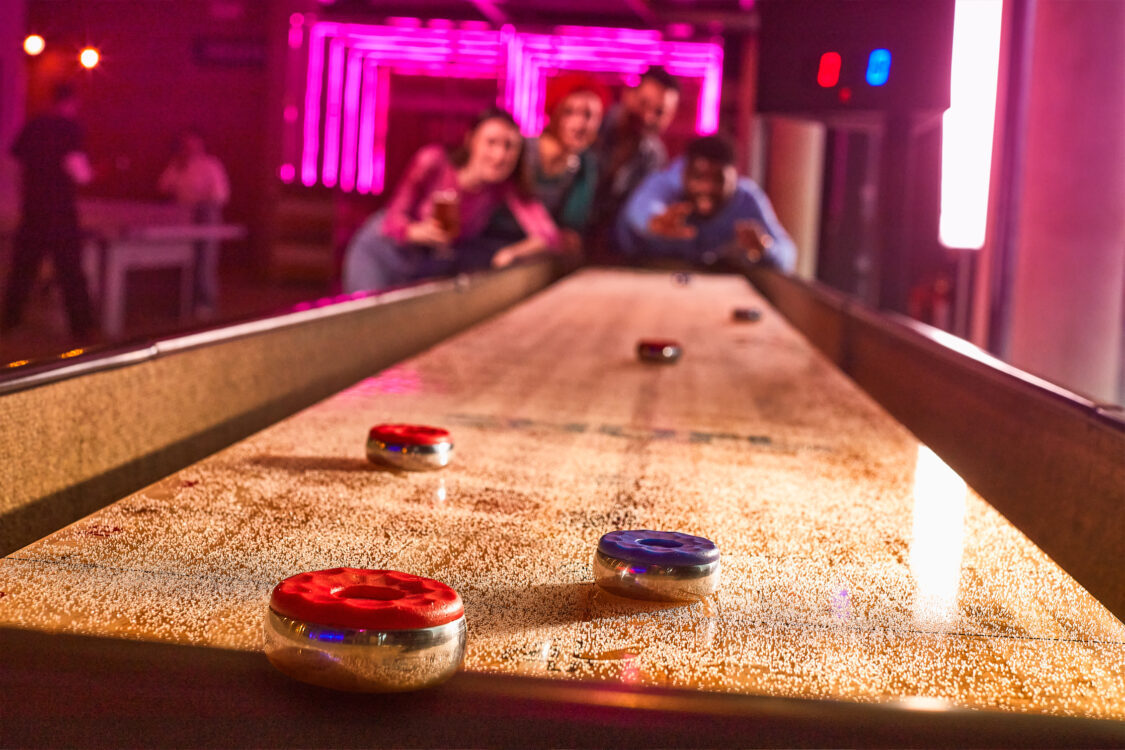
It’s one of the first things you notice in gameplay, yet isn’t even visible. The board looks flat, but the moment the puck leaves your hand it starts to move differently. It glides, drifts, and finds its line. That movement comes from the SHUFL Curve, a carefully designed concave playing surface that adds shape and imagination to the game, opening up myriad more ways to get your pucks past your opponent.
What is the SHUFL Curve?
The SHUFL Curve is created by adding a precise concave to the maple playing surface, through finely-tuned climatic adjusters (tension rods) hidden beneath the table. These subtle beams allow the board to be set perfectly for its environment, keeping the same gentle dip through the centre that defines every SHUFL table. The result is a surface that stays true and consistent while bringing the puck to life with natural movement and control.
How The Curve Helps Beginners
For beginners, the curve makes the game of shuffleboard easier to pick up and enjoy. On a flat board, a small mistake sends your puck off the side, and out of play. The curve draws the puck gently back towards the centre, keeping more shots alive. It builds confidence and encourages new players to experiment.
The discovery process is obvious to watch. The first few throws are guesswork, the next few they start to clock something, and then the moment comes when someone realises, “It’s curved!” From that point, they start talking, sharing tips, and trying new angles together. The curve turns practice into part of the fun.
How The Curve Challenges Experienced Players
Once you understand the basics, the curve adds depth and precision. Advanced players learn to use it like a contour map, predicting the path their puck will swing through. It turns shuffleboard into a tactical game.
You start to see shots that didn’t exist before. You use the bend to slide around an opponent you thought had blocked you off. You are able to knock off a puck and stay on the board yourself. It opens up more opportunities, angles and gaps, and the better you get, the more the board gives back.
The Showpiece
Watching others play, the curve attracts attention. People stop to watch the pucks arc and bend under the lights. It looks effortless and precise at the same time.
You can see that reaction instantly in a venue. Punters pause to form an audience, and before long, they want a turn themselves. The curve has that rare quality of looking beautiful while also being technically clever. Especially in videos, you can see the difference straight away. It draws people in initially in curiosity, before the physics start to make sense, and all the while it’s oddly cathartic to watch.
That is why a SHUFL table so often becomes the centre of a space. It looks good, it plays beautifully, and it makes people want to stay.
Tips: How to Play the Curve
1. “Let It Curve You”
This mildly-spiritual sounding mantra is my number one point of preaching for a reason.
When playing a shot to pass an opponent on either side, the most common mistake is trying to fight the board. If you start on the same side as you want to curve, you will only lose out. Start from the opposite side and let the puck drift naturally, like a skateboard rolling down one side of a halfpipe and up the other.
The board will carry you round if you let it. Once you stop forcing the line and start trusting the table, the game becomes smoother and far more satisfying.
2. Play the Mirror
Your opponent has a high-scoring puck tucked near the corner? Don’t start on the same side to knock it off.
When you want to knock off a puck, think in reverse. If the target is on the left, start from the right. Slide at a nice, steady pace, and gravity will pull your puck through the centre and out the other side.
3. Lock In Your Line
To make your shot more predictable, you need to remove the variables. Use a ‘finger-rail’ or ‘span’ shot. That means at least two fingers slide along the edge of the board while your thumb is positioned across the top of the puck. Set the angle with your wrist. The shot should come from the shoulder and hips, not the wrist, which should stay fairly firm through the release.
Keep the motion straight and steady. When everything moves in one line, you can reproduce the same shot every time. That consistency is what lets you start playing with precision rather than luck.
4. Use the Curve as Your Shield
The curve isn’t just about attack; it’s also a brilliant defensive tool.
Most good shots draw a soft ‘question mark’ shape across the board. The shot bends very gradually at first and then sharpens as it slows. Learning to see those shapes is one of the real pleasures of the game.
Start a round with a puck placed early towards the far end of the 1-point scoring zone. If your opponent doesn’t yet understand the board, they will waste a turn trying to knock it off, and either come off too, or only score one point if they successfully stay on.
If they miss, that first puck becomes your marker, and future blocker. You can now send your next one in that gentle, bending, question-mark line, to curve in behind it, safe from a straight attack. You are setting traps with geometry. Once you see that work once, you realise how much strategy the curve allows.
5. Control the Pace
Most new players try to “beat” the curve with speed, which as I noted earlier, almost always sends the puck off the end of the board. You only need enough energy to reach and either drop behind, or make contact and remove the opponent’s puck.
Think about the distance: after travelling eighteen feet, the puck only needs the tail end of its momentum to knock an opponent clear. Any more is a waste, and likely to result in your puck flying off with the opponent. Yes, they can’t score if they’re not on the board, but neither can you, and they’re up next.
Remember, as the puck slows near the far end, the curve steepens and the bend becomes stronger. That slowing movement is what lets you tuck in behind and stay on the board. So, use control over power – unless of course the whole thing is just a therapy session/tantrum for you.
Show Off Your Curves.
If you have a curved shot to show off your own, send it to us or tag @thesocialgaminggroup or @joeyshufl so we can see it.
You can also find your nearest SHUFL table on our SHUFL World Map, or get in touch to arrange a demo, purchase for your venue, or just challenge us to a game!
Written by Joey Bartram, shuffleboard enthusiast and SHUFL team member since 2019.
You may also like


Franchise
B2B
You need to load content from reCAPTCHA to submit the form. Please note that doing so will share data with third-party providers.
More InformationYou are currently viewing a placeholder content from Turnstile. To access the actual content, click the button below. Please note that doing so will share data with third-party providers.
More Information