What the science of social fitness tells operators about designing social arenas people come back to
In 2010, a landmark study found that the quality of a person’s social relationships is a bigger predictor of early death than obesity, physical inactivity, and on a par with smoking. The researchers weren’t studying loneliness as a side note. They were measuring it as a primary health variable.
That finding has since been built on substantially. The concept of social fitness – the idea that social connections require deliberate maintenance, the same way physical fitness does – has moved from academic research into mainstream conversation. And the implications for how operators design and run social venues are more direct than most people in the industry have stopped to consider.
What the research actually says
Professor Robert Waldinger, who runs the Harvard Study of Adult Development – one of the longest-running studies on wellbeing ever conducted – found that relationships wither from neglect. The people with the richest social lives aren’t the most extroverted. They are the most intentional. They actively maintain connections.
Tegan Cruwys, an associate professor and clinical psychologist at the Australian National University, went further. Following 4,000 adults over six years, she found that group-based social connections are particularly powerful: joining a group and sticking with it reduced symptoms of depression, cut the risk of relapse, and protected against future episodes.
The critical distinction in her work: a one-on-one friendship is valuable, but it doesn’t change how you see yourself. Being part of something bigger does. Group identity – thinking of yourself as a member of a community, not just a person with friends – is what carries the protective effect.
Group-based social connection is the biggest predictor of cognitive health and protection against depression.
Cruwys et al., Social Science & Medicine, 2013
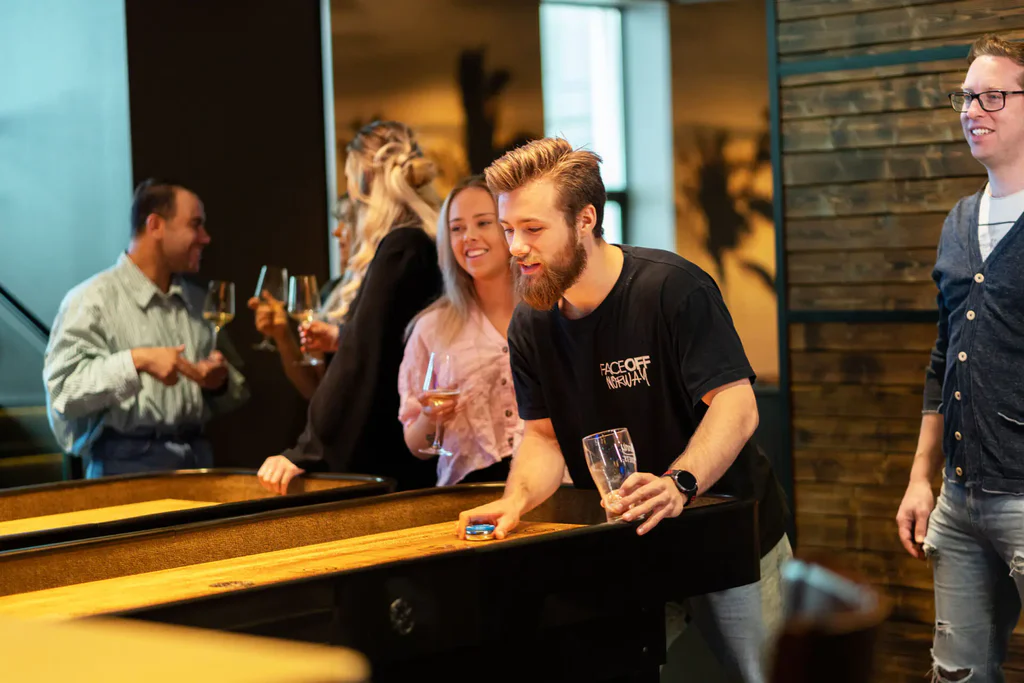
In the midst of SHUFL.
What this means for social gaming venues
Most hospitality venues optimise for the first visit. Marketing spend, covers, footfall. These are the metrics that make sense when a restaurant or bar is built around the transaction: a meal, a drink, an evening.
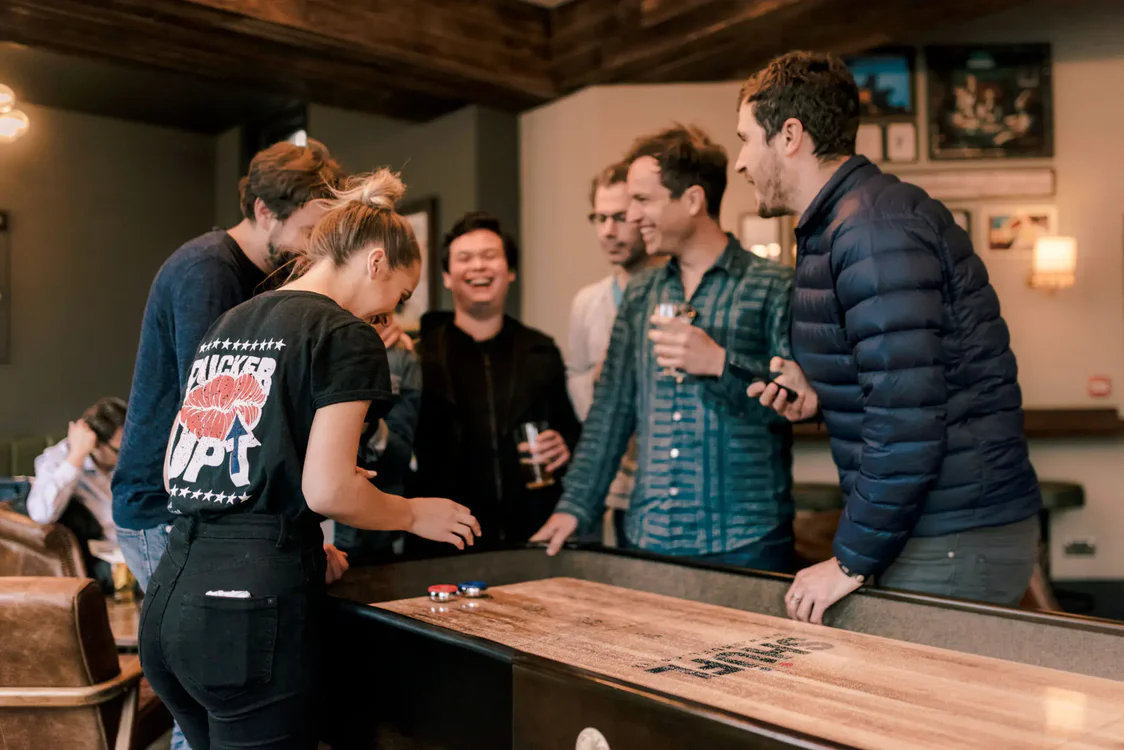
Social gaming venues have a structurally different opportunity. The games are genuinely better with regular players. Shuffleboard with strangers is fun. Shuffleboard with the same four colleagues who have been playing for six months, who have running jokes and a shared set of house rules, is something else entirely. It builds the kind of group identity that Cruwys’ research identifies as the active ingredient in social wellbeing.
This is not accidental. It is a function of design. The operators who understand this build for the second, third and tenth visit from the start – in their game mix, their layout, their booking model, their staff culture. They are not just running a venue. They are, whether they think about it this way or not, building the infrastructure for their guests’ social fitness.
“What we found was that perfectly good relationships will often wither away from neglect – and that the people who were best at having vibrant social networks were the people who took care of them.”
Prof. Robert Waldinger, Harvard Study of Adult Development
The planning conversation most operators aren’t having
In TSGG’s experience working with partners across Europe, the most successful social gaming venues share a common planning mindset: they think about the repeat visit from the outset. What brings a group back on a Thursday night, three months after they first came? What makes the experience better with familiarity? How does the booking flow work for regulars versus new guests?
These questions change decisions about game selection, spacing, sight lines, and the balance between walk-in and booked capacity. They also change how staff are trained and how the venue communicates with guests after the first visit.
The science of social fitness gives this a name and a mechanism. But the operators who are already asking these questions have arrived at the same conclusion from a purely commercial direction: returning groups are more profitable, less price-sensitive, and more likely to bring new people with them.
Both readings point at the same design priority. Build for the regulars.
A note on what ‘well-designed’ actually means
Social fitness research suggests that the mere exposure effect – our tendency to like people we see regularly – kicks in after roughly two months of repeated contact. That means a new guest who comes to a social gaming venue four or five times in their first two months is on the threshold of something that actually changes how they relate to the space and the people in it.
Getting a guest to that threshold is partly a product decision (the games need to be worth coming back for) and partly an operational one (the experience needs to be consistent enough to build familiarity). Both are within an operator’s control. Neither happens by accident.
If you’re thinking about how your venue is designed for repeat visits – game mix, layout, booking model – that’s a conversation TSGG has with every partner before a venue opens. It’s one of the more useful ones.
Subscribe to The Play List for more on what the research says about social gaming and hospitality.
You may also like
Franchise
B2B
You need to load content from reCAPTCHA to submit the form. Please note that doing so will share data with third-party providers.
More InformationYou are currently viewing a placeholder content from Turnstile. To access the actual content, click the button below. Please note that doing so will share data with third-party providers.
More Information